


Search Engine Optimization For Photographers: How Photographers Can Get Found (And Booked) Online

Ever wondered why some photographers consistently land on Google’s first page while others struggle to get noticed? In this post, I’m sharing what you need to know about search engine optimization for photographers in clear, everyday language. No confusing tech talk required. I’ve explored this topic in depth before on the blog, but this time we’re keeping things simple and practical while pointing you to resources if you want to dig deeper. So if you’ve been curious about how search visibility really works, and what you can do to improve yours, you’re in the right place.
Table of Contents
But before we dive in—Hi! I’m Melissa—an SEO expert helping portrait photographers get found by dream clients on Google, without the tech overwhelm. Whether you want done-for-you services, coaching, or blogging strategies, I’ve got you covered. Ready to stop being the best-kept secret in your market?
Want the full conversation? Listen to the podcast episode with Alison & me. Prefer to skim? This post breaks it all down step-by-step so you can start implementing right away.
What Is Search Engine Optimization for Photographers?
So what exactly is search engine optimization for photographers? You will also see this called “SEO.” In simple terms, it’s about making your website easy for Google to understand. When someone searches for something, like a photographer in their area or a recipe using specific ingredients, Google scans the internet to find the most relevant results. SEO helps your site show up in those searches by clearly telling Google who you are, what you offer, and where you fit among all the other options.
Think of it like organizing a giant digital filing system. When your website is properly optimized, you’re helping Google categorize your business so the right people can find you at the right time.
Unlike paid ads, SEO helps you show up in search results organically. That means you’re not paying for visibility—you’re earning it. It’s free marketing for your photography business. That makes SEO one of the most powerful long-term tools for growing your business online.
Why does SEO matter for photographers?
Your Google ranking matters more than most people realize, because that’s how new clients are finding you. Think about your own search habits. You probably click results on the first page, maybe glance at page two, and almost never go further unless you’re really digging for something specific. So if your site is sitting on page 12, potential clients simply aren’t seeing you.
And here’s what’s really interesting… people who find you through Google are often the easiest clients to book. They’re already searching for exactly what you offer, which means they’re usually ready to buy. That’s very different from social media, where people are often just scrolling for inspiration rather than actively looking to hire someone.
Plus, it works even when you’re not. You can wake up to inquiries that came in overnight while you were sleeping, spending time with family, or focusing on other parts of your photography business. Your website is essentially working for you 24/7.
That’s why learning search engine optimization for photographers can be such a game-changer. You can pay someone like me for a one-time SEO setup, or choose to learn how search engine optimization for photographers works yourself so you can keep improving your visibility no matter where your business, or your life, takes you next.
And looking ahead, SEO is only becoming more important. With the rise of AI-powered search tools, your website now has the chance to show up in more places than just traditional Google results. When your content is well optimized, it can pull double duty and start helping potential clients find you through both search engines and AI-driven search experiences.
Choosing The Right Keywords For Better Search Engine Optimization for Photographers
At the heart of search engine optimization for photographers is one simple concept: keywords. These are the exact words and phrases people type into Google when they’re looking for something.
Think about how you search. If you needed a photographer, you wouldn’t just type “photographer” and hope for the best. You’d get specific — maybe “family photographer in Austin” or “newborn photographer near me.” You’d include the type of photographer you need and the location, because you want results that actually apply to you.
That’s the mindset you want to use when setting up your website. Step out of business-owner mode for a second and just think like a normal person using Google. What would your client type into that search bar? What would feel natural to them? Set your website up around those phrases.
And yes, I know “ideal client” can feel like one of those buzzwords everyone throws around. But in this case, it really just means thinking about how your people search. What stage of life are they in? What are they looking for? Sometimes you might even be your own ideal client, which makes it easier. Either way, don’t overcomplicate it — this part really is common sense once you get out of your own head..
Using keyword research tools
A great shortcut here is Google’s autocomplete feature. Start typing something into the search bar and watch what Google suggests. Those suggestions pop up because people are already searching for them. It’s a quick way to see what real search behavior looks like and even get ideas you hadn’t thought of.
Then, once you’ve got some obvious phrases, you can go a step further and use keyword tools to make sure people are actually searching for them and that there’s enough traffic to make it worth targeting. If you want to go deeper on that, I have a post here that breaks down SEO keyword strategy in more detail.
Improving Search Engine Optimization for Photographers
Once you’ve figured out your keywords, the next step is putting them to work on your site, starting with your homepage. The key here, and with any task improving search engine optimization for photographers, is breaking it down into bite-sized pieces so it doesn’t feel overwhelming.
Your homepage needs to clearly answer a few basic questions: who you are, what you do, and where you serve. Think back to those basic questions from school: who, what, where, why, how. Your website should answer those almost immediately. Because if someone lands on your page and can’t tell where you’re located or what you offer, they’re confused — and confused visitors leave. If your clients can’t tell where you are, Google can’t either.
That first section of your homepage is especially important because it helps new visitors quickly figure out if you’re right for them. You’re either attracting your ideal client or gently pushing away the people who aren’t a good fit, which is actually a win. You’re connecting with the right audience while also helping your SEO at the same time.
Technical Ways To Improve Search Engine Optimization for Photographers
Then there are a couple technical pieces that really matter for rankings: your page title and meta description. Your main keyword needs to show up in both. And this is where people often make mistakes by splitting things up — putting “family photographer” in one place and the city somewhere else. Instead, keep your main keyword phrase together and use it consistently. It should show up in your main header, your page title, your meta description, and naturally throughout the page.
When all of those pieces line up, your homepage becomes much easier for Google to understand — and much more likely to show up when the right clients are searching.
Does Blogging Help With SEO?
Absolutely, yes!
Here’s the thing: when someone searches on Google, they’re not being shown whole websites. Google serves individual pages. So every single blog post you write becomes its own page that answers a specific question or search. And every one of those pages is a new chance for someone to find you.
So think about the kinds of searches your clients are making. Think local expert content, helpful resources, specific topics. Things like best locations for family photos in Arlington, or gluten-free dessert places in Charleston, or how to prepare for a newborn session. Session prep, local guides, mom resources, client education — the list goes on and on!

Each blog post gives Google another opportunity to match your site with a search. And unlike social media posts that disappear after a day or two, blog posts keep working for you for years. Many photographers are still getting clients from posts they wrote years ago because those pages keep showing up in search results.
If you need topic ideas or blogging help, check the show notes — we’ve linked resources there to make things easier. And honestly, we’ve talked about blogging so much on the podcast that there are multiple episodes you can go back and listen to if you want a deeper dive — and don’t worry, we’ve linked those for you so you don’t have to go hunting for them.
Image Search Engine Optimization for Photographers
Another piece people often forget about is image SEO. And this one’s simple: Google can’t actually see your photos the way people do. Even though AI is getting better, it still gets things wrong, so you don’t want to rely on that. Which means you have to help Google out.
Renaming Images for SEO
Stop uploading photos called something like IMG_1234.jpg. When you’re naming your images, they should match the keyword for the page or blog post they live on. So if your post is something like best photo locations in Arlington, your image file names should reflect that (think like: best-photo-locations-in-arlington.jpg) or something very close to it. That does way more for your SEO than uploading files named image123 or IMG_4567.
Adding Alt Text for SEO
Don’t skip alt text either. Alt text is where you describe what’s actually happening in the photo, and it’s another chance to naturally include your keyword. A simple way to do that is to describe the image first and then work your keyword in. For example, you might write something like: family session at Cove Park, one of the best locations for photography in Arlington. That way the description is helpful and your keyword is still included naturally.
Images can actually drive traffic on their own, too. When your images are named properly, they can show up in Google Image search. A lot of photographers notice their photos popping up in image results after publishing new posts, especially when they’ve named files around specific locations or venues.
One of my favorite things when I was a wedding photographer was publishing a new blog post with all the images named for that location, then checking Google Image search a week later and seeing my photos showing up everywhere. When people click those images, they end up on your website. So image SEO isn’t just busy work — it can actually bring in real traffic.
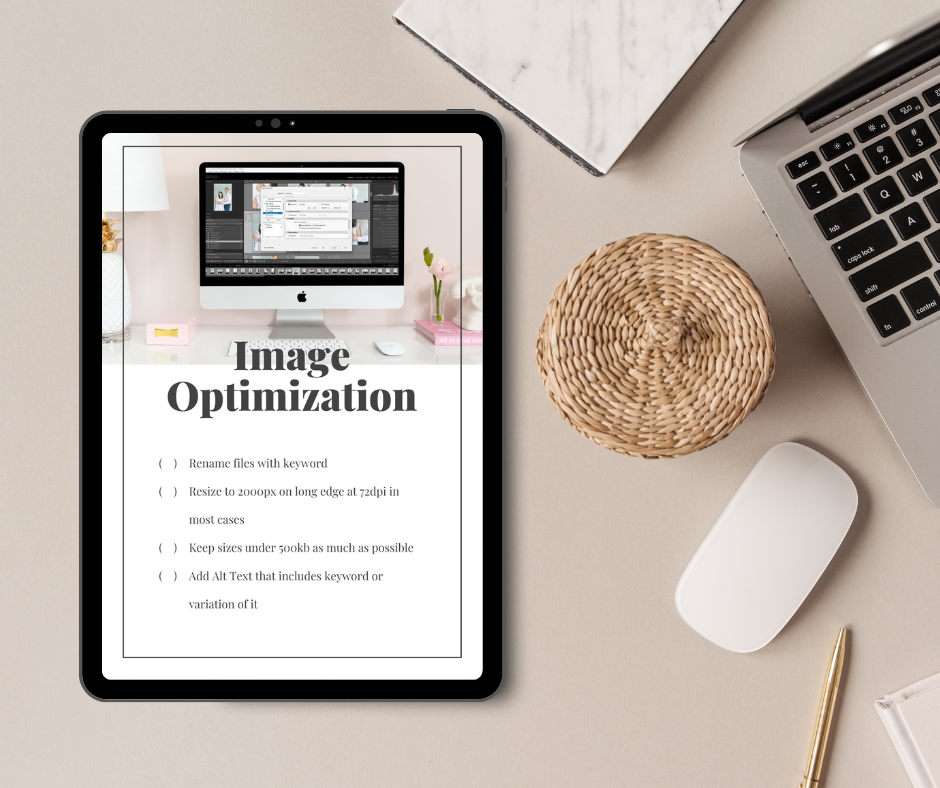
If you’re thinking, “Okay, but how do I remember all this?” I’ve got you covered. Download my image optimization checklist so you have file naming, sizing, specs, and alt text guidelines handy whenever you need them. Grab it here!
Getting Your Photography Website On Google
Another important step is getting your website indexed on Google. This is done through Google Search Console, which basically tells Google that your website exists.
To do that, you submit what’s called a sitemap. Think of it as a map of your website that lists all your pages and URLs so Google knows where everything is and can properly organize your site in search results.
The good news is most website platforms or SEO plugins automatically generate this sitemap for you. All you usually need to do is copy the sitemap URL and submit it through Google Search Console.
And if you’re thinking, “What even is Google Search Console?” don’t worry — there’s a step-by-step blog post for setting Google Search Console up here that walks you through getting everything set up. Head there next and you’ll have your photography website properly indexed in no time.
If you liked this post, we think you’ll love these:
What Is Evergreen Blog Content & Why Photographers Need It Now
Mastering Local SEO for Photographers During a Business Move
Photography Revenue Streams During a Move: Income Solutions That Work
Wondering why your website isn’t bringing in inquiries? I’m covering the 5 biggest SEO mistakes photographers make in my free masterclass.
Watch now → https://pictureperfectrankings.com/5-mistakes


I’m Melissa Arlena, founder of Picture Perfect Rankings, where we help portrait photographers get found on Google and transform from invisible experts into market leaders. With 15+ years of photography experience and an IT background, I’ve helped hundreds of photographers break free from feast-or-famine cycles by achieving page 1 rankings that attract their dream clients through search.

Leave a Reply


I'm Melissa Arlena(my friends call me Mel) and I help photographers get found on Google.
Read more about me

I'm so glad you're here
Hello!

© 2023-2026 Picture Perfect Rankings : SEO for photographers. all rights reserved. privacy policy.